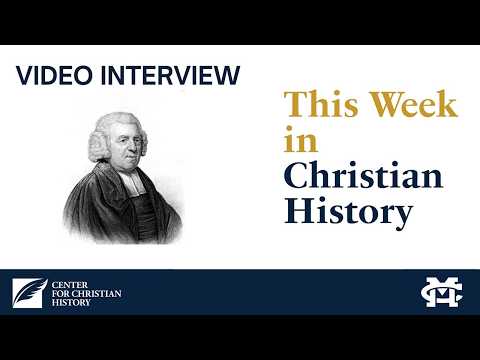
Full Video Interview 55: Conversion of John Newton with Dr. Bruce Hindmarsh
Bruce Hindmarsh
62.56
9 March 2026
8 April 2026
Website: https://www.centerforchristianhistory.com
Instagram: https://www.instagram.com/centerforchristianhistory/
Facebook: https://www.facebook.com/christianhistorytoday/
Donate: https://www.centerforchristianhistory.com/donate
The Conversion of John Newton: From Slave Trader to “Amazing Grace”
The story of John Newton is one of the most powerful conversion narratives in the history of Christianity. Known today as the author of the beloved hymn Amazing Grace, Newton’s life journey—from slave trader to Anglican pastor—has become one of the most widely remembered testimonies of repentance and redemption in the Christian tradition.
This full video interview features a conversation with church historian Bruce Hindmarsh of Regent College. Dr. Hindmarsh is one of the leading scholars of evangelical history and eighteenth-century Christianity. His work has explored the development of conversion narratives, evangelical spirituality, and the broader religious movements that shaped the modern Christian world.
Born in London in 1725, John Newton spent much of his early life at sea. His father was a shipmaster in the Mediterranean trade, and Newton entered maritime life at a young age. By his late teens he had already experienced hardship, rebellion, and a series of difficult circumstances that shaped his early character. Newton eventually became involved in the transatlantic slave trade, serving aboard ships that transported enslaved Africans across the Atlantic.
Newton’s life changed dramatically during a violent storm in the North Atlantic in March 1748. Believing the ship might sink at any moment, Newton cried out to God for mercy. He later described this moment as the beginning of his spiritual awakening. Though his moral transformation unfolded gradually over time, the experience marked the turning point that redirected his life.
In the years that followed, Newton slowly moved away from the slave trade and toward a life shaped by Christian faith. Eventually he pursued ordination in the Church of England and became an Anglican minister. Newton served congregations in Olney and later in London, where he became known not only for his pastoral work but also for his mentorship of younger Christians and reformers.
Newton’s legacy is also closely tied to his contributions to Christian hymnody. Working with poet William Cowper, he helped produce the Olney Hymns collection in 1779. Among those hymns was “Amazing Grace,” a song that has become one of the most recognizable and widely sung hymns in the history of Christianity. The hymn reflects Newton’s deep personal awareness of divine mercy and his conviction that God’s grace could redeem even the most unlikely lives.
Late in life Newton also spoke publicly against the slave trade in which he had once participated. His reflections and testimony became influential during the growing abolition movement in Britain. Newton’s friendship with reformer William Wilberforce and his willingness to acknowledge the horrors of the trade contributed to the broader campaign that eventually led to its abolition within the British Empire.
Today, John Newton’s life stands as a powerful reminder of the themes that have shaped Christian history for centuries: repentance, redemption, and the transforming power of faith. His story continues to resonate across cultures and denominations, reminding believers that the message of grace lies at the heart of the Christian gospel.
This interview is part of the ongoing work of the Center for Christian History at Mississippi College. The Center is committed to preserving and sharing the real story of Christianity by connecting the public with leading historians, scholars, and historical research.
Through conversations with subject matter experts from around the world, the Center seeks to make the history of the Church accessible to both scholars and the general public. These interviews explore the people, events, and movements that have shaped Christianity across the centuries.
Learn more about the Center for Christian History and explore additional interviews, podcasts, and historical resources.
John Newton (1725–1807), engraving. Public domain. Wikimedia Commons.