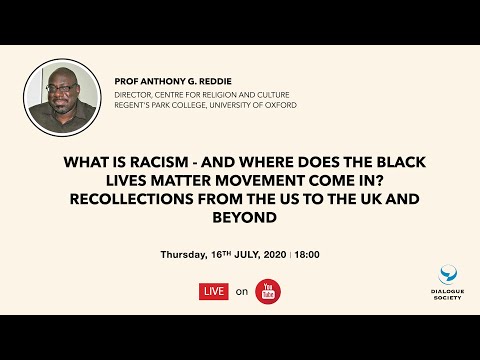
What is racism - and where does the Black Lives Matter movement come in? | Prof Anthony G. Reddie
Anthony Reddie
60.16
16 July 2020
20 August 2025
Dialogue Society hosts a discussion by Prof Anthony G. Reddie on "What is racism - and where does the Black Lives Matter movement come in? Recollections from the US to the UK and beyond". Speaker Prof Anthony G. Reddie, Professor Extraordinarious with the University of South Africa (UNISA) in Theological ethics, and, Director of Centre for Religion and Culture at Regents Park, University of Oxford Abstract Leading heated debates through the past few weeks, the discussion around racial equality, global solidarity and critical analysis of structural features on racism both in the US, UK and beyond has highlighted grievances from BAME communities. Illustrated in our streets and public spheres this discussion with Professor Reddie intends to unpack crucial elements of the discourse and dynamics surrounding the Black Lives Matter movement. Firstly, what is the Black Lives Matter movement and how did it start? What are its aims and objectives? What changes are demanded - how have these become global interest, has this global interest shaped demands further? What are the key debates within the movement? And finally, does "Black Lives Matters" really mean "other lives" don't matter - has a slogan of equality been exploited? Keep in tune for our event with Professor Reddie on Thursday the 16th of July for a stimulating discussion. About Prof Anthony G. Reddie Professor Reddie's research interests lie at the intersection of Black liberation theology and Practical theology. His scholarly work has focused on developing a Participative model of Black theology that seeks to impact on the consciousness of ordinary Black people, particularly those living in inner-city, poor communities in Britain. Focusing on Black theology, his research has been recognised by international bodies, particularly within the Republic of South Africa, where I am a Professor Extraordinarious with the University of South Africa (UNISA) in Theological ethics. As a Research Fellow with UNISA his more recent publications were put in for scholarly assessment in the South African National Research Foundation (NRF), which is the equivalent of the UK REF. With a research output at an 'A Rating', he has been identified as a 'Leading International Researcher'. He is the first Black scholar in theology and religious studies to be given this rating in the history of the NRF in South Africa. He has been the editor of Black Theology: An International Journal (published three times a year by Taylor and Francis) since March 2002. www.tandfonline.com/yblt. He was born and brought up in Bradford, West Yorkshire in a family of Caribbean migrants, who were part of the Windrush Generation. His undergraduate and postgraduate studies were undertaken at the University of Birmingham, first in Church History (BA Hons, 1987) and later with a PhD in Education (with Theology), in 2000. Within the College, he directs the Centre for Religion and Culture that is an interdisciplinary, postgraduate centre that is comprised of a number of Research Fellows and Associates. His role to co-ordinate the activities of the Centre, organising conferences and seminars, plus supporting colleagues in the development of their scholarship. As well as supervising research students at Masters and Doctoral levels within the University of Oxford. He also enjoys Jazz, watching classic 1940s Hollywood film noir and sipping fine malt whisky. Subscribe http://bit.ly/SubsDialogueSociety Donate https://www.paypal.me/DialogueSociety Become a patron https://www.patreon.com/DialogueSociety Visit us http://www.dialoguesociety.org Sign up to our newsletter http://eepurl.com/du5E6X Twitter https://twitter.com/DialogueSociety/ Instagram https://www.instagram.com/dialoguesociety/ Facebook https://www.facebook.com/DialogueSociety About Dialogue Society The Dialogue Society is a registered charity (Registered Charity Number: 1117039), established in London in 1999, with the aim of advancing social cohesion by connecting communities, empowering people to engage and contributing to the development of ideas on dialogue and community building. The Dialogue Society is not a religious or ethnic organisation. It aims to facilitate dialogue on a whole range of social issues, regardless of any particular faith or religion. It stands for democracy, human rights, the non-instrumentalisation of religion in politics, equality, and freedom of speech.