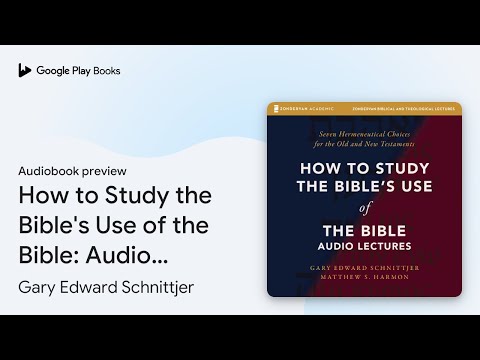
How to Study the Bible's Use of the Bible:… by Gary Edward Schnittjer · Audiobook preview
Gary Edward Schnittjer
15.24
13 October 2024
27 November 2025
PURCHASE ON GOOGLE PLAY BOOKS ►► https://g.co/booksYT/AQAAAEBS_nq-OM
How to Study the Bible's Use of the Bible: Audio Lectures: Seven Hermeneutical Choices for the Old and New Testaments
Authored by Gary Edward Schnittjer, Matthew S. Harmon
Narrated by Gary Edward Schnittjer, Matthew S. Harmon
0:00 Intro
0:03
0:44
4:17
10:51
15:03 Outro
#garyedwardschnittjer
—
GOOGLE PLAY BOOKS
Find your next great read with Google Play Books.
Google Play Books is a global digital bookstore offering ebooks, audiobooks, comics, and manga. Discover book recommendations personalized just for you.
Get the iOS app: https://goo.gle/books-ios
Get the Android app: https://goo.gle/books-android
—
BOOK DESCRIPTION
The Zondervan Biblical and Theological Lectures series provides a unique audio learning experience. Unlike a traditional audiobook's direct narration of a book's text, How to Study the Bible's Use of the Bible: Audio Lectures include high quality live–recordings of college–level lectures that cover the important points from each subject as well as relevant material from other sources.
How to Study the Bible's Use of the Bible: Audio Lectures by Gary Edward Schnittjer and Matthew S. Harmon is an essential resource aimed at teaching a hermeneutic for understanding the Bible's use of the Bible. Intended for students of both testaments, the series' innovative approach demonstrates how the Old Testament use of Scripture provides resources for the New Testament authors' use of Scripture. Lessons provide students with a clear approach to handling the Bible's use of itself through seven key hermeneutical choices organized into individual videos. Each lesson introduces a hermeneutical choice and then provides several examples of the Old Testament use of Old Testament and the New Testament use of Old Testament. The plentiful examples model for students the need to ground hermeneutics in biblical evidence and provide insight into understanding why the Bible's use of the Bible is important.
Session Titles and Runtimes:
0.1 – Introduction: Overview (4 min)
0.2 – Introduction: The Seven Hermeneutical Choices (7 min)
0.3 – Introduction: Definitions (5 min)
1.1 – Sequestered versus Connected: Sequestering the Use of Scripture in the Old Testament (5 min)
1.2 – Sequestered versus Connected: Sequestering the Use of Scripture in the New Testament (7 min)
1.3 – Sequestered versus Connected: The Teachings of Jesus Connect the Use of Scripture in Both Testaments (5 min)
2.1 – Adjusting Meaning and/or Adjusting Context versus Advancement of Revelation: "Jewish" Exegesis in the New Testament (6 min)
2.2 – Adjusting Meaning and/or Adjusting Context versus Advancement of Revelation: Sensus Plenior (5 min)
2.3 – Adjusting Meaning and/or Adjusting Context versus Advancement of Revelation: Advancement of Revelation (6 min)
2.4 – Adjusting Meaning and/or Adjusting Context versus Advancement of Revelation: Case Study of the Use of Hosea 1:1 in Matthew 2:15 (8 min)
3.1 – Detecting Allusions as Art versus Science: Evidence for Allusions (7 min)
3.2 – Detecting Allusions as Art versus Science: Evaluating Evidence for Allusions (7 min)
3.3 – Detecting Allusions as Art versus…
—
ABOUT THE AUTHOR
Gary Edward Schnittjer (PhD, Dallas Theological Seminary) is distinguished professor of Old Testament in the School of Divinity at Cairn University. He is the author of the award–winning book Old Testament Use of Old Testament, Torah Story, now in its second edition, and Old Testament Narrative Books: The Israel Story.
—
AUDIOBOOK DETAILS
Purchase on Google Play Books ►► https://g.co/booksYT/AQAAAEBS_nq-OM
Language: English
Publisher: Zondervan Academic
Published on: October 8, 2024
ISBN: 9780310142546
Duration: 2 hr, 58 min
Genres: Religion / Biblical Criticism & Interpretation / New Testament, Religion / Biblical Criticism & Interpretation / Old Testament, Religion / Biblical Reference / Handbooks, Religion / Biblical Studies / Exegesis & Hermeneutics