Debating Israel's Salvation | Glaser, Moo, VanGemeren, & Feinberg (2 of 2)
Douglas Moo
51.06
2 August 2013
20 August 2025
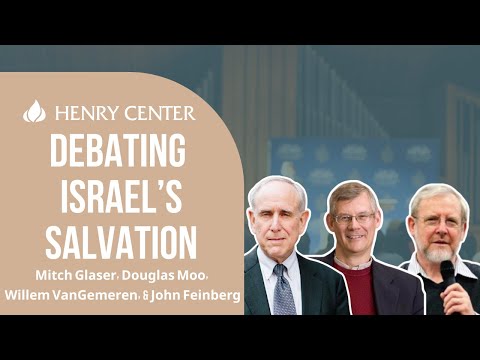
Debate Question - How and When Will All Israel Be Saved? In Romans 11 Paul makes the case that God has not cast off his people Israel, despite their rejection as a nation of Jesus, their Messiah. His final argument that God isn't finished with Israel is that "all Israel will be saved" (Rom 11:25-27). What did Paul mean and how will this come to pass? Who constitutes "Israel," the biological seed of Abraham or his spiritual seed? Is the salvation in view spiritual, national, socio-economical, or all of these? Has this promise been fulfilled during the NT era by individual Jews and Gentiles turning to Christ and hence "filling up" the "all Israel?" Or is the promise to be fulfilled in the end-times at the return of Christ? If the latter, will only those biologically Jewish be saved, or will there also be a massive turning to Christ among the Gentiles? Whatever the answers to such questions, what are the implications for how Christians should understand the modern state of Israel? And, of most practical importance, how should one's understanding of Rom 11:25-27 impact one's attitudes toward and efforts in evangelizing Jews? Mitch Glaser (PhD Fuller Theological Seminary) is President of Chosen People Ministries. He is co-editor of To the Jew First: The Case for Jewish Evangelism in Scripture and History (Kregel Academic, 2008) and The People, the Land, and the Future of Israel: Israel and the Jewish People in the Plan of God (Kregel Academic, 2014). Douglas J. Moo (PhD University of St. Andrews) is Kenneth T. Wessner Professor of New Testament at Wheaton College. He is author of The Letter to the Romans (NICNT; 2nd edition) (Eerdmans, 2018) and A Theology of Paul and His Letters: The Gift of the New Realm in Christ (Zondervan Academic, 2021). He currently serves as chair for the New International Version translation committee. Willem A. VanGemeren (PhD University of Wisconsin) is Professor Emeritus of Old Testament and Semitic Languages at Trinity Evangelical Divinity School. He is author of a number of books, including Interpreting the Prophetic Word: An Introduction to the Prophetic Literature of the Old Testament (Zondervan Academic, 1996) and Psalms (Expositor's Bible Commentary) (Zondervan Academic, 2008). John S. Feinberg (PhD University of Chicago) is Professor Emeritus of Biblical and Systematic Theology at Trinity Evangelical Divinity School. He is author of No One Like Him: The Doctrine of God (Crossway, 2004), Ethics for a Brave New World (Crossway, 2010), and Light in a Dark Place: The Doctrine of Scripture (Crossway, 2018). The Henry Center for Theological Understanding provides theological resources that help bridge the gap between the academy and the church. It houses a cluster of initiatives, each of which is aimed at applying practical Christian wisdom to important kingdom issuesfor the good of the church, for the soul of the theological academy, for the sake of the world, and ultimately for the glory of God. The HCTU seeks to ground each of these initiatives in Scripture, and it pursues these goals collaboratively, in order to train a new generation of wise interpreters of the Wordlay persons and scholars alikefor the sake of tomorrow's church, academy, and world. Visit the HCTU website: https://henrycenter.tiu.edu/ Subscribe to the HCTU Newsletter: https://bit.ly/326pRL5 Connect with us! https://twitter.com/henry_center https://www.facebook.com/henrycenter/ https://www.instagram.com/thehenrycenter/ https://www.linkedin.com/company/thehenrycenter