Religious Freedom and Anti-Semitism in Contemporary Europe: Q&A and Panel (Pt. 5 of 5)
Robert P George
37.57
16 November 2017
20 August 2025
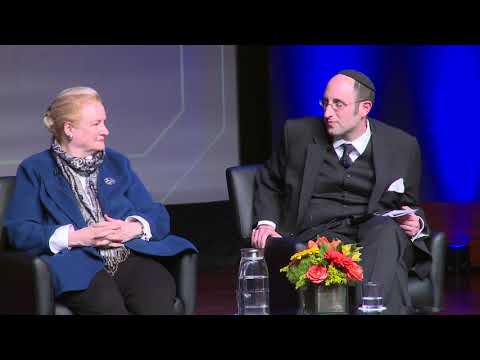
On Monday November 6th 2017, The King's College and Princeton University's James Madison Program in American Ideals and Institutions hosted a panel that explored the sources of and possible responses to the revival of Anti-Semitism in Europe. Following the Second World War, the world said "never again" to the hatred that produced the Holocaust, but Anti-Semitism, which was never fully eradicated in Europe, has returned with a vengeance. According to the French Interior Ministry, over 50 percent of France's bias motivated crimes in 2014 targeted Jews, even though French Jewry makes up less than one percent of the population. The currents driving this tragedy across Europe are several: the scapegoating of Jews for social decline by right-wing nationalists; the radicalization of Muslim immigrants by certain extremist Imams goading them to violence; and the "open-mindedness" of secularized Europe, which refuses to acknowledge Islamist violence and combat it. This toxic environment has led some to ask whether the Jews living in Europe today may soon leave the continent altogether. Rabbi Dr. David G. Dalin, Panelist Rabbi Dr. David G. Dalin, a widely-published scholar of American Jewish history and Jewish-Christian relations, is Professor Emeritus of History and Politics at Ave Maria University. He has been a Visiting Professor at the Jewish Theological Seminary, George Washington University and Stern College of Yeshiva University. He has also been the Taube Research Fellow at the Hoover Institution at Stanford University, and a Visiting Fellow at the James Madison Program in American Ideals and Institutions at Princeton University. Rabbi Dalin, who was ordained at the Jewish Theological Seminary and received his Ph.D. from Brandeis University, is the author, co-author or editor of twelve books, including Religion and State in the American Jewish Experience and Icon of Evil: Hitler's Mufti and the Rise of Radical Islam and his most recent publication, Jewish Justices of the Supreme Court, from Brandeis to Kagan, in April 2017 by Brandeis University Press. His articles and reviews have appeared in American Jewish History, First Things, Commentary, The Weekly Standard and the American Jewish Year Book. Professor Mary Ann Glendon, Panelist Mary Ann Glendon is the Learned Hand Professor of Law at Harvard University and a former U.S. Ambassador to the Holy See. She was a member of the United States Commission on International Religious Freedom from 2012 to 2016 and currently serves as a member of the Board of Superintendents of the Institute for Religious Works (Vatican Bank). She was President of the Pontifical Academy of Social Sciences from 2004 to 2014, and has represented the Holy See at various international conferences including the 1995 U.N. Women's conference in Beijing where she headed the Vatican delegation. Her books include Rights Talk; A Nation Under Lawyers; A World Made New: Eleanor Roosevelt and the Universal Declaration of Human Rights; and The Forum and the Tower (2011). Rabbi Dr. Meir Y. Soloveichik, Panelist Rabbi Dr. Meir Y. Soloveichik is Director of the Zahava and Moshael Straus Center for Torah and Western Thought at Yeshiva University and rabbi at Congregation Shearith Israel in Manhattan, the oldest Jewish congregation in America. He graduated summa cum laude from Yeshiva College, and was ordained by Yeshiva's seminary. In 2010, he received his doctorate in religion from Princeton University. Rabbi Soloveichik has lectured throughout the United States, in Europe, and in Israel to both Jewish and non-Jewish audiences on topics relating to Jewish theology, bioethics, religious freedom, wartime ethics, and Jewish-Christian relations. Professor Robert P. George, Moderator Robert P. George is McCormick Professor of Jurisprudence and Director of the James Madison Program in American Ideals and Institutions at Princeton University. He is also the Herbert W. Vaughan Fellow of the Witherspoon Institute and has been a Visiting Professor at Harvard Law School. He has served as Chairman of the U.S. Commission on International Religious Freedom and as a presidential appointee to the U.S. Commission on Civil Rights. He has also served on the President's Council on Bioethics and as the U.S. member of UNESCO's World Commission on the Ethics of Science and Technology. He was a Judicial Fellow at the Supreme Court of the United States, where he received the Justice Tom C. Clark Award. A Phi Beta Kappa graduate of Swarthmore College, he holds degrees in law and theology from Harvard and the degrees of D.Phil., B.C.L. and D.C.L. from Oxford University, in addition to eighteen honorary degrees. He is a recipient of the U.S. Presidential Citizens Medal and the Honorific Medal for the Defense of Human Rights of the Republic of Poland, and is a member of the Council on Foreign Relations.