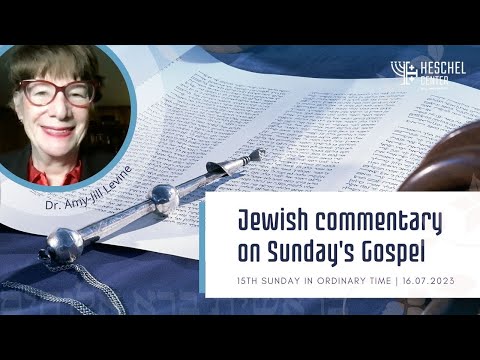
Stories not only for children – parables heard with first-century Jewish ears - dr. Amy Jill-Levine
Amy-Jill Levine
4.47
16 July 2023
21 March 2026
Generally, people regard parables as children’s stories with a simple message: the Good Samaritan means we should help injured people; the Prodigal son means that G-d forgives sinners, and so on. But to stop at the level of childhood is to miss the profound nature of the parables.
A form of storytelling well known in Jewish sources, parables are designed not simply to instruct, but to help us re-think our actions and our relationships.
How do we hear parables with first-century Jewish ears, ears that initially heard the story?
First, we recognize that parables, like all stories, open to multiple interpretations. Jesus describes a #sower (Himself? A missionary?Anyone?), who broadcasts #seeds indiscriminately, on the #path, on #rocky soil, amid thorns. #Grain was expensive, and #farmers were careful to sow their seed on already plowed and fertilized #soil. This is no ordinary sower.
We next learn that birds ate the seed on the pathway, that the sun scorched the seed on rocky #ground, that thorns choked still more seed. But the seed on the good soil yielded an excellent #harvest. What are we to do with this strange sower and his strange story?
The #disciples don’t know, so they ask Jesus in private. Jesus blesses their eyes and ears for seeing and hearing, respectively, the Messiah and the Gospel. They are the #insiders. People on the outside, he suggests, will not #understand.
Then, Jesus provides an allegorical #explanation: the seeds are #people who are #evangelized. Some lack understanding and are deceived by Satan; some fall away when faced with #persecution; some are choked by anxiety or wealth; some remain #faithful.
Insiders vs. outsiders; disciples vs. crowds; saved vs. damned – it all seems neat and tidy.
There are four major problems with this neat and tidy explanation.
-
First, as we know from the rest of the #Gospel, the disciples consistently fail to #understand Jesus. Judas betrays him; #Peter denies him; all flee from #Gethsemane. The insiders clearly miss the message. Yet outsiders – Peter’s mother-in-law, a man suffering from leprosy, a woman suffering hemorrhages, a gentile centurion pleading on behalf of an enslaved member of his household, a Canaanite woman, an unnamed woman who anoints Jesus, the centurion at the cross – display understanding. Outsiders may be the more faithful, and that those who think of themselves as privileged because of insider status should think again.
-
Second, while Jesus provides this parable an allegorical explanation, most #NewTestament parables lack explanations. Therefore, they are #invitations to all readers to discover meanings for themselves.
-
Third, the allegory suggests that disciples are to #spreadTheGospel to all, regardless of their judgment of the soil. They can never know which seeds will take #root. The disciples are to #proclaimTheGospel and then live it by feeding the hungry, clothing the naked, visiting people in prison…; they are not to judge who are insiders or outsiders, saved or damned.
-
Fourth, the parable suggests that soil does not change. But it does, as Luke 13.6-9, the parable of the unproductive #figTree, tells us. In that parable, when the #landowner wants to uproot the unproductive tree, the #gardener responds, “Let it alone for another year, until I dig around it and put manure on it.”
Soil can be made more productive;
rocks can be cleared away;
thorns can be uprooted.
Even seeds eaten by birds will return to the soil. They are never lost.
The good news is that no seed, no one, is without the possibility of #repentance and #redemption.
The warnings are against #judgingOthers and against boasting of #insider status.
The challenge is that we all should work to ensure that the soil is fertile – we do that by nurturing others and by removing whatever rocks and thorns prevent #wholeness and #shalom. The yield when we heed the #GoodNews, attend to the warnings, and accept the #challenge, is enormous.
About the author:
Amy-Jill Levine is University Professor of New Testament and Jewish Studies Emerita and Mary Jane Werthan Professor of Jewish Studies Emerita at Vanderbilt University. She is also Rabbi Stanley M. Kessler Distinguished Professor of New Testament and Jewish Studies, Hartford International University for Religion and Peace. In the spring of 2019, she became the first Jew to teach a course on the New Testament at the Pontifical Biblical Institute in Rome; in 2021, she was elected a member of the American Academy of Arts and Sciences.